
Google I/O 2026, Day 1: Gemini Eats Everything (Part 1)
Google opened I/O 2026 today by doing what everyone expected: shouting “Gemini” at every product until the brand stuck to the walls. Android news? Mostly parked for later, because day one was 100% “agentic Gemini era”, straight from Sundar’s mouth.
Table of Content
- Gemini becomes Omni (and does video)
- Gemini 3.5 Flash: the “fast but not dumb” model
- Antigravity 2.0: not just a copilot, a farm of agents
- Gemini Spark: your personal daemon process
- Search grows actual agents (and custom UIs)
- Docs Live and Ask YouTube: AI in the boring places
- Google Pics, Omni creativity, and “please watermark this”
- Intelligent eyewear: Gemini on your face
- Infrastructure flex: TPU 8 and insane capex
- And Android in all this?
Gemini becomes Omni (and does video)
Centerpiece of the show: a new model family called Gemini Omni. The idea is simple: any input in, any output out, starting with video.
- Omni is a “world model” that’s supposed to reason about physics, images, and complex scenes instead of just predicting the next token.
- First concrete product: Gemini Omni Flash, launched today in the Gemini app, Google Flow, and even embedded in YouTube Shorts.
- You type (or talk), optionally add images or clips, and it spits out a coherent video you can then tweak conversationally.
Basically, they took the “text → image → video” race and went, “Cool, what if the model actually understood the scene instead of faking it with particle effects?” We’ll see how it behaves once people ask it to “explain quantum physics with cats in anime style.”
Gemini 3.5 Flash: the “fast but not dumb” model
If Omni is the fancy new toy, Gemini 3.5 Flash is the daily grinder meant to sit behind… everything.
Google’s pitch in dev-speak:
- Better than Gemini 3.1 Pro on almost all benchmarks, especially coding and “economically useful tasks” (their words, not mine).
- Four times faster than other “frontier” models when you look at output tokens per second.
- Cheap enough that Google’s own internal workloads jumped from half a trillion to over three trillion tokens processed per day in a few weeks.
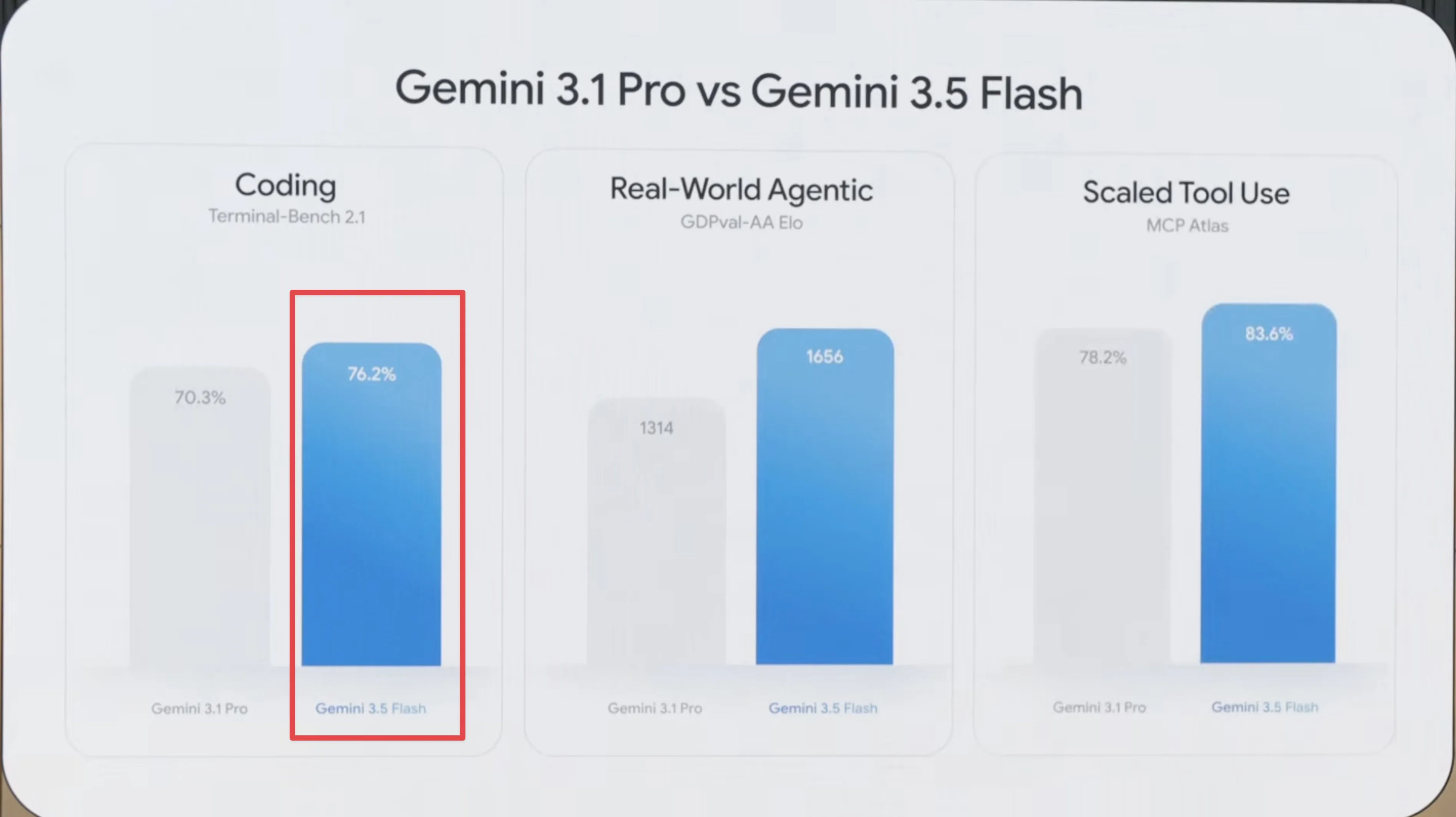
Available today in the Gemini app and via APIs, and it’s already wired into their dev tools and Antigravity. TL;DR: this is the one your backend will likely end up calling because finance won’t approve Omni everywhere.
Antigravity 2.0: not just a copilot, a farm of agents
Remember when Google talked about AI coding assistants? Cute. Now they’re pushing Antigravity as an “agent-first development platform” to manage whole cohorts of autonomous agents.
Version 2.0 brings:
- A standalone desktop app where you can orchestrate agents like a devops SRE board, but for bots.
- A super-optimized version of Flash that’s not just 4x but 12x faster than other frontier models inside Antigravity.
- Tools to design workflows where agents code, test, call APIs, and generally do the boring stuff you pretend to automate “later”.
The subtext: they want you to build SaaS on top of Google agents, not just LLM prompts in a loop. Good news: great for shipping faster. Bad news: your Jira board will now include tickets assigned to bots.
Gemini Spark: your personal daemon process
For end users, the big reveal is Gemini Spark: a permanent AI agent wired into your Google life.
What Spark does:
- Runs on dedicated VMs in Google Cloud, 24/7, so it keeps working even when your laptop is closed.
- Uses Gemini 3.5 + Antigravity under the hood for long-running tasks and background workflows.
- Connects first to Google tools, then third-party services via MCP in the coming weeks.
- Lives in the Gemini app, soon in email/chat, and later this year in Chrome as an “agentic browser”.
On Android, Spark gets its own UI area called Android Halo, a live dashboard for ongoing agent tasks. Rollout starts now for trusted testers; beta lands “next week” for Google AI Ultra subscribers in the US.
Your shell scripts just got competition from a SaaS daemon with marketing.
Search grows actual agents (and custom UIs)
Search is now officially in the “agentic” era, which is a fancy way to say: it will work in the background and mess with its own UI.
Two main upgrades:
- Information agents: personalized AI agents that run 24/7 to track stuff for you and ping you when it’s relevant, starting this summer for paid Google AI Pro and Ultra users.
- Generative UI: Search dynamically builds layouts, visuals, and even persistent dashboards (“mini apps”) for longer tasks you keep coming back to.
The dashboards are editable experiences powered by Antigravity directly inside Search, again starting with paid users in the US. So yes, Google is turning the search box into a low-code runtime that remembers your weird side projects.
Docs Live and Ask YouTube: AI in the boring places
Because the future must also touch documents and videos, Google pushed two user-facing features hard: Ask YouTube and Docs Live.
Ask YouTube:
- Lets you ask questions directly in YouTube and get a conversational answer that links to exact moments in relevant videos.
- Rolling out broadly in the US this summer after early tests with Premium users.
Docs Live:
- You just talk; it transcribes your brain dump and structures a document around it.
- Editing and layout changes are also voice-driven, plus it can pull info from Gmail, other Docs, and the web.
- Starts rolling out to subscribers this summer, with similar voice features coming to Gmail and Keep.
If you hate writing specs, this is your moment. If your PM discovers this, prepare for 5x more “quick docs” to review.
Google Pics, Omni creativity, and “please watermark this”
On the creative side, Google unveiled Google Pics, an AI image creation and editing tool powered by its latest Nano Banana model. Yes, that’s the actual name.
Key points:
- Treats every element as an object, not a flat bitmap, so you can move, swap, and refine specific parts instead of regenerating whole images.
- Works for both fresh generations and editing existing photos or designs.
- Available now to trusted testers; rolling out later this summer to Google AI Pro and Ultra subscribers in Workspace.
Given how easy this makes synthetic content, they also beefed up SynthID and Content Credentials.
- SynthID has already watermarked over 100 billion images and videos plus “60,000 years” of audio.
- Content Credentials verification is coming to Search, Chrome, and the Gemini app so you can see if media is camera original or AI-modified.
- New partners adopting SynthID: OpenAI, Kakao, and ElevenLabs, alongside Nvidia from last year.
Translation: they’re finally treating “is this AI?” as a first-class UX question, not a blog post footnote.
Intelligent eyewear: Gemini on your face
Yes, there was hardware, but very Google: intelligent eyewear rather than a full-blown headset drop.
Two flavors:
- Audio glasses with spoken Gemini assistance in your ear.
- Display glasses that overlay information when you need it while keeping you “heads up and hands free.”
Audio glasses launch first, this fall, with display versions teased as “coming”. No hard specs yet—just the promise that Gemini will follow you around without making you look like a 2013 Glass Explorer.
Meanwhile, they also reminded everyone that Android XR and partner hardware are still in the pipeline for later this year.
Infrastructure flex: TPU 8 and insane capex
Because no keynote is complete without some “look how big our cloud is” slide, Sundar dropped numbers.
- Google expects 180–190 billion dollars in capex this year, roughly six times 2022.
- New dual-chip TPU generation: TPU 8t for training and TPU 8i for inference.
- 8t delivers nearly 3x the compute of the previous gen and can scale training across more than 1 million TPUs globally.
- Both chips promise up to 2x better performance-per-watt.
The message: all these agents and Omni toys exist because they’re burning an absolutely ridiculous amount of silicon in the background.
And Android in all this?
Android and Wear didn’t get center stage today for one simple reason: Google already did a dedicated Android Show: I/O Edition last week. That’s where they showed Material 3 Expressive, Android 16 niceties, Gemini all over Chrome and Android Auto, and even Quick Share talking to iPhones.
Today’s keynote just hinted that Android 17 and XR updates will keep rolling out over the two-day event and beyond. So expect part 2 of this saga to be much more “mobile dev” and a bit less “AI eats the world… again”.
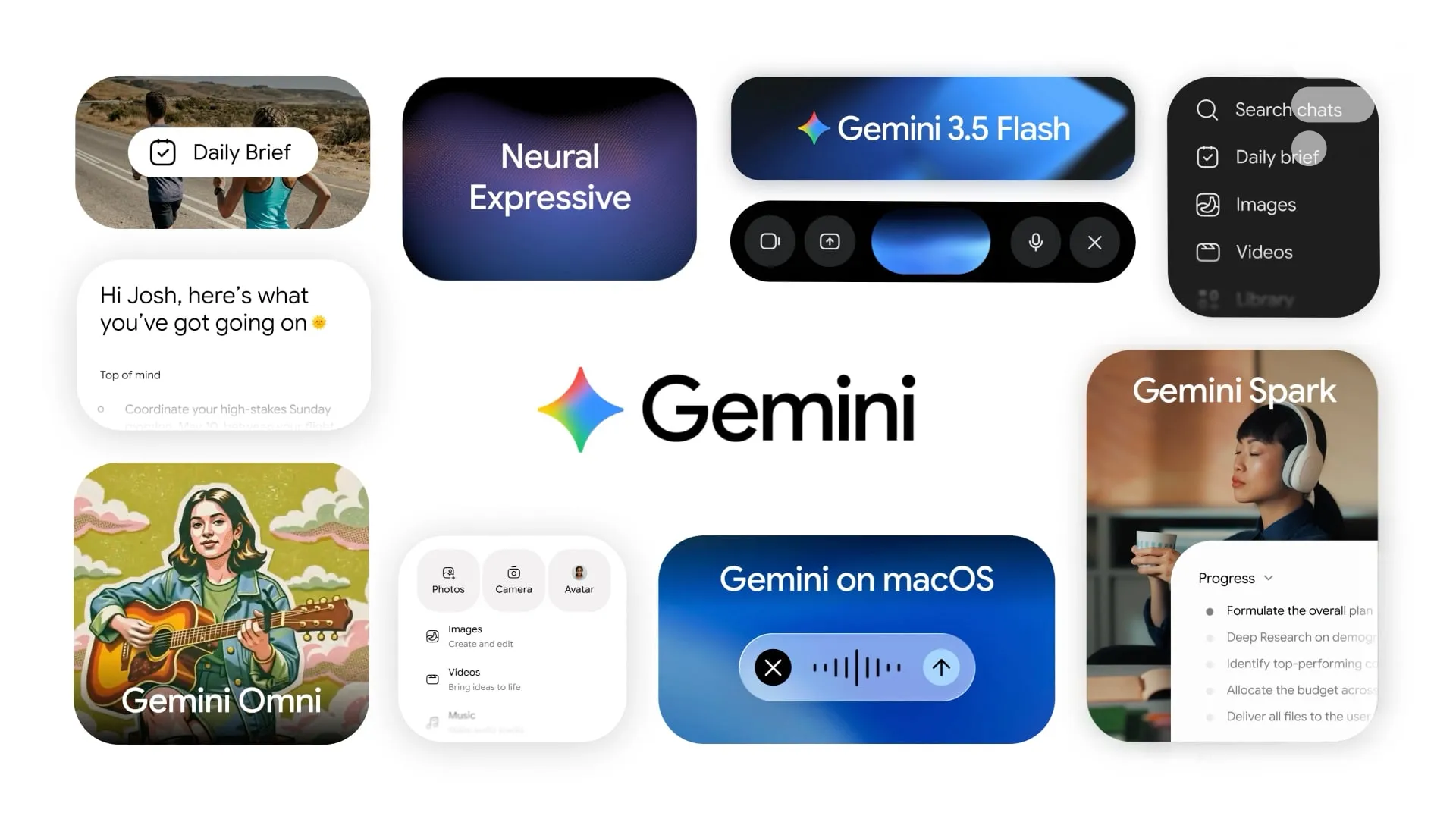
Day 1 verdict: Google basically turned “AI assistant” into an operating system for everything—Search, Chrome, Docs, YouTube, even glasses—and gave developers the Antigravity + Flash toolkit to wire their apps into that agent zoo. Tomorrow, they still have to prove that all this actually helps ship real apps and not just more keynote demos, so stay tuned for part 2.