
Gemma 4 In A Duck: 3D‑Print Your Own Google I/O Robot
Table of Content
- The day a duck crashed Google I/O
- Meet Open Duck Mini
- Gemma 4: the brain you actually control
- What you need to print your own
- High‑level “busy dev” build path
- Adding Gemma 4 on top
- Why this is more than a cute toy
The day a duck crashed Google I/O
Google I/O 2026 was supposed to be about “agentic AI”, TPUs and the usual cloud fireworks. And yet, half of dev Twitter was busy filming… a small wobbling robot duck.
Under the cute shell: Open Duck Mini, an open‑source bipedal droid about 42 cm tall, inspired by Disney’s BDX robot. Bill of materials is under 400 dollars if you do not go full RGB gamer mode.
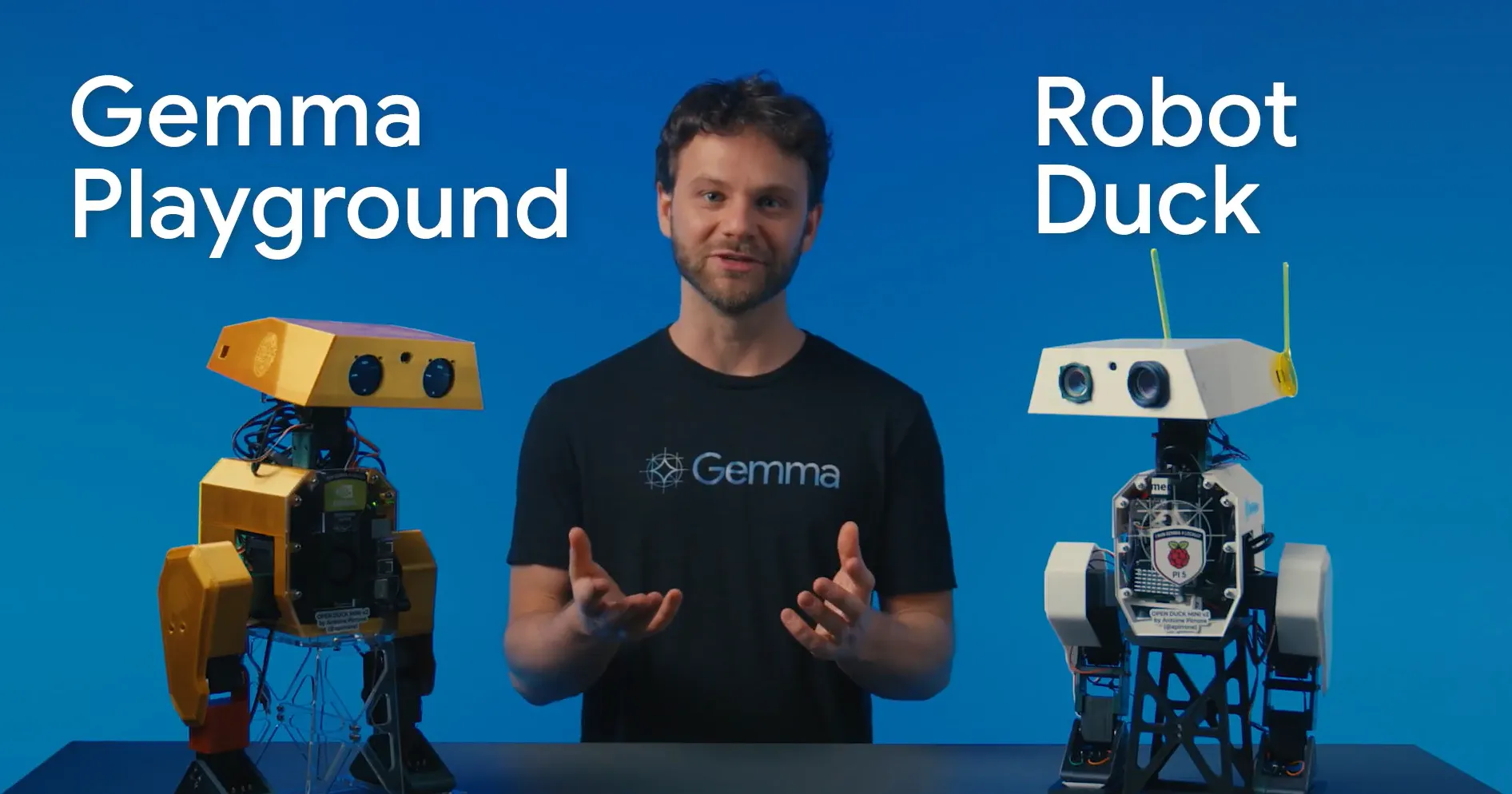
On top of that, some demos wired the duck to Google’s new open model Gemma 4, running locally via WebGPU and other tricks. Yes, the “AI future” is now a slightly unstable bird walking toward you.
Meet Open Duck Mini
Open Duck Mini is a fully open hardware and software project led by Antoine Pirrone. The goal: a small biped robot that you can 3D‑print, assemble, and teach to walk with reinforcement learning.
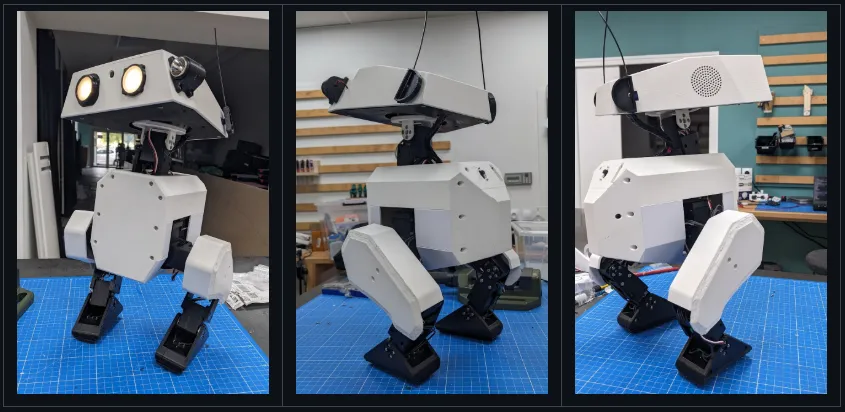
The bot stands roughly 42 cm tall with legs extended, 3D‑printed in PLA/TPU, driven by 12 Feetech STS3215 servos and a Raspberry Pi Zero 2W or similar controller. The project ships CAD files, mujoco simulation, training code, and runtime so you can go from sim‑to‑real, not just a pretty statue on your shelf.
The repo is very honest about the current state of things: it’s a “working repo” with undocumented scripts and TODOs everywhere. So yes, perfect fit for developers.
Gemma 4: the brain you actually control
Gemma 4 is Google’s newest open model family, built on the same research as Gemini 3, but released under an Apache 2.0 license. That means you can download the weights, run them locally, and hack them however you like without praying to some SaaS dashboard.
Models are sized to run on phones, laptops, workstations, and accelerators, with 4B and larger variants that handle multi‑step reasoning and agent workflows. The dev marketing is all “agentic AI”, but for our use case it simply means: a duck that can think in more than three tokens.
Some I/O demos already showed Gemma 4 running via WebGPU, with credits to Open Duck Mini for the robot design. So the “Gemma 4‑powered duck” is not a meme, it’s an actual stack people are shipping in the wild.
What you need to print your own
If you already own a 3D printer and can git clone without hurting yourself, you are 70% there.
Hardware, roughly:
- 3D‑printed frame in PLA/TPU for the full body.
- 12× Feetech STS3215 servos for the legs and joints.
- 1× Raspberry Pi Zero 2W (or a more powerful board like RDK X5 if you want extra brain).
- IMU sensor (BNO055) and battery pack (3S Li‑ion).
Total BOM: under 400 dollars if you follow the official list and do not gold‑plate the duck.
Software side:
Open_Duck_Minifor CAD, simulation and general project hub.Open_Duck_Mini_Runtimefor the Raspberry Pi / controller code.Open_Duck_Playgroundfor MuJoCo RL training and experiments.
All repos are Apache‑licensed, which is nice when you inevitably copy‑paste half the code into your own monstrosity.
High‑level “busy dev” build path
The real docs are on GitHub and YouTube, but here is the TL;DR build flow seen in community guides.
- Print the shell and frame Slice the provided STL files, print in PLA/TPU, pray to the warping gods, repeat.
- Assemble servos and legs Pre‑configure each servo zero position, then build hips, knees and ankles in the recommended order to avoid later alignment pain.
- Mount brain and sensors Install Raspberry Pi or RDK X5, IMU, battery, route cables so they do not get shredded by the joints.
- Bring up the runtime
Flash Linux, enable SSH and I2C, install Python, clone
Open_Duck_Mini_Runtime, run the test scripts for IMU and motors. - Run the walking policy Grab the pretrained ONNX policy and launch the MuJoCo‑trained walking script from the runtime repo. At this point, your duck should stand up and do its best “baby giraffe” impression.
From there you can re‑train policies in simulation, tweak rewards, and generally waste your weekends on gait tuning.
Adding Gemma 4 on top
Out of the box, Open Duck Mini focuses on locomotion, not conversation. Gemma 4 brings the “agent” layer you can glue on top for planning, voice, or task logic.
Typical stack idea:
- Run Gemma 4 on a nearby machine with a GPU or on a beefier board than the Pi.
- Expose a tiny HTTP or WebSocket API for “duck brain” decisions: go here, follow that person, say something snarky.
- Have the runtime on the robot poll that API, translate high‑level commands into joint‑space actions via the existing controllers.
People already demoed Gemma 4 running locally via WebGPU with explicit shout‑outs to Open Duck Mini’s design, so the combo is very much supported by reality. You get an embodied agent that does not depend on some remote LLM endpoint, which is neat if you care about latency, privacy, or just your internet bill.
Why this is more than a cute toy
Open Duck Mini is a pretty great playground if you are into RL, sim‑to‑real, or just want something cooler than yet another TODO app. You get CAD, mujoco envs, reference motion generation, TensorBoard logging, the whole applied ML pipeline in a form factor that fits on your desk.
Combine that with Gemma 4’s open weights and Apache license, and you have a fully hackable embodied agent stack you can fork, self‑host, and abuse in any side project. No black boxes, no “contact sales”, just a duck, some servos, and a model that does not care if you strap it to a robot or a coffee machine.
If your 3D printer has been gathering dust, this is probably the most fun way to turn plastic and Python into something vaguely alive. And worst case, you end up with a failed print that still looks good on the shelf, which is more than most AI projects can say.